VMock vs Hatch
VMock evaluates resume quality across static benchmarks. Hatch reconstructs resumes directly around target roles.



What VMock is built for
VMock is structured around score-based resume analysis.
Users upload a resume and receive automated feedback aligned to job titles, industries, and predefined success criteria. The platform evaluates elements such as formatting, keyword alignment, and general resume quality, then assigns scores across categories.
The system emphasizes diagnostic evaluation. It identifies areas that may be weak and provides general recommendations for improvement.
For institutions, this offers scalability. Large student populations can receive standardized baseline feedback without requiring direct staff involvement.
However, when optimization is driven primarily by scoring benchmarks, there is a risk that students begin optimizing toward the score itself rather than toward specific employer requirements. High scores may not always translate into stronger outcomes for particular job postings, especially when industry nuances or role-specific expectations vary.
In environments where hiring expectations shift quickly, maintaining alignment between static scoring models and evolving employer standards can require additional oversight and recalibration.
Who Hatch is built for
Hatch is built for users and institutions that prioritize job placement outcomes over score optimization.
Hatch approaches resume improvement differently.
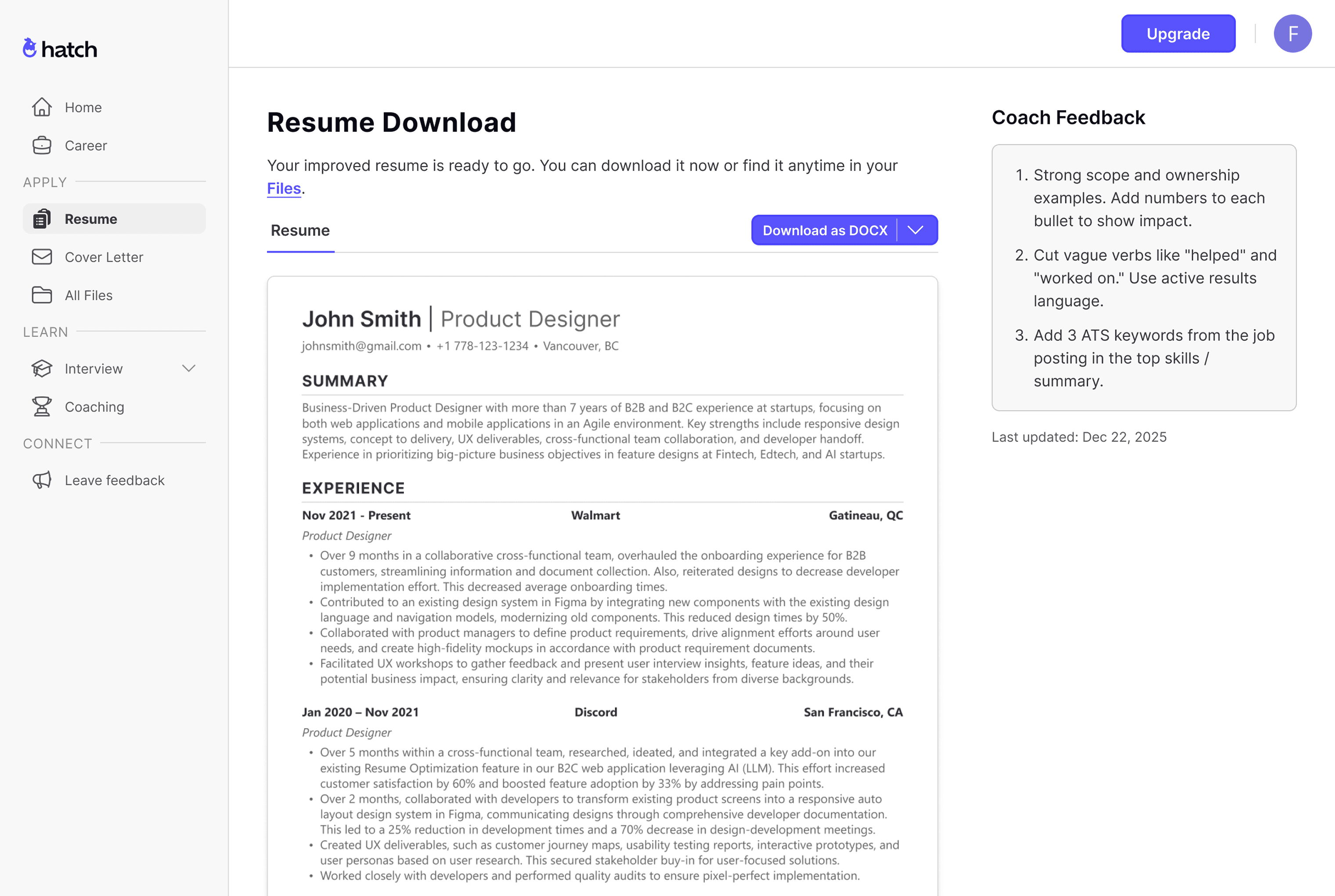
Rather than centering on scoring models or predefined benchmarks, it centers on applied reconstruction tied directly to the job description at hand. The system rewrites and restructures resumes around specific roles, incorporating quantified impact, contextual alignment, and semantic coherence within the requirements of that position.
Instead of surfacing generalized improvement categories, it generates a role-specific draft aligned to the exact position a user is targeting.
Because each application is rebuilt in context, alignment is dynamic rather than benchmark-bound. Users are not optimizing toward a static score. They are optimizing toward the expectations of a specific employer at a specific moment.
The emphasis is not just evaluating quality, but directly improving it in a way that translates to real application readiness without requiring manual recalibration from staff. Otherwise, users will come to 1:1 sessions with higher-quality deliverables and better preparedness.
Resume Support: Evaluation vs Applied Execution
Both platforms aim to improve resume quality.
VMock evaluates resumes against structured criteria and industry benchmarks. Feedback must be interpreted and applied by the user, which is time consuming and doesn't work for anyone with ESL.
Hatch embeds revision expertise into the system itself. It reconstructs experience, strengthens measurable outcomes, and integrates keywords within narrative context. Hatch operates within minutes, requiring minimal user input.
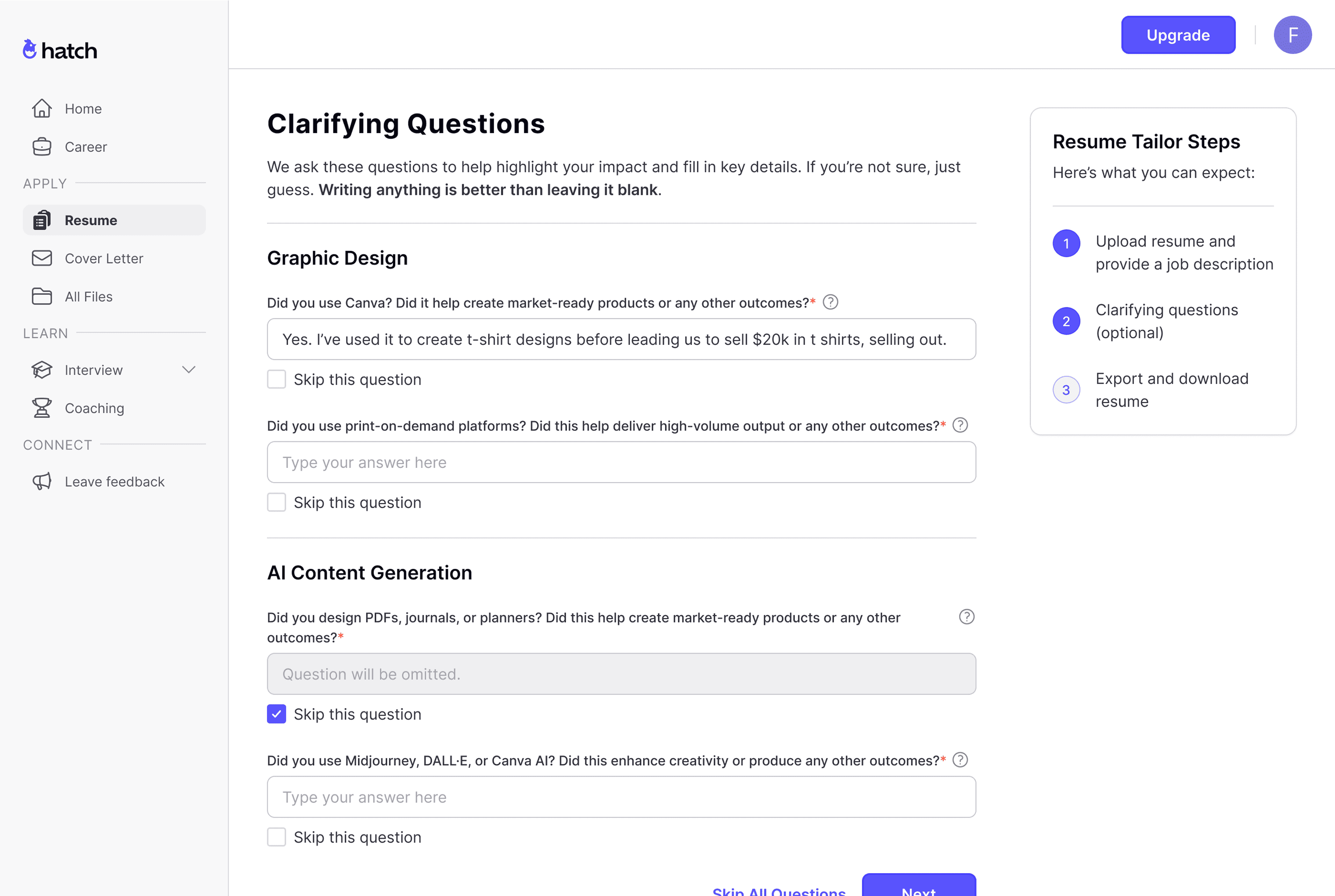
Unlike competitors like Jobscan or VMock, Hatch will never hallucinate information. Our agentic AI will always ask for clarification from the user to surface new skills and wins they may not have remembered otherwise.
The difference is not whether feedback exists. It is where execution happens.
Evaluation-based systems simply surface issues. Reconstruction-based systems resolve them.
For highly self-directed users who are comfortable translating abstract feedback into concrete revisions, scoring platforms can be sufficient.
For users who want applied, role-specific rewriting with reduced ambiguity, reconstruction can streamline the process.
For Institutions: Standardization vs Applied Outcomes
At scale, both platforms offer institutional value.
VMock provides standardized scoring across large student populations. This allows universities to measure baseline resume quality and track improvement metrics across cohorts but does not track employment outcomes.
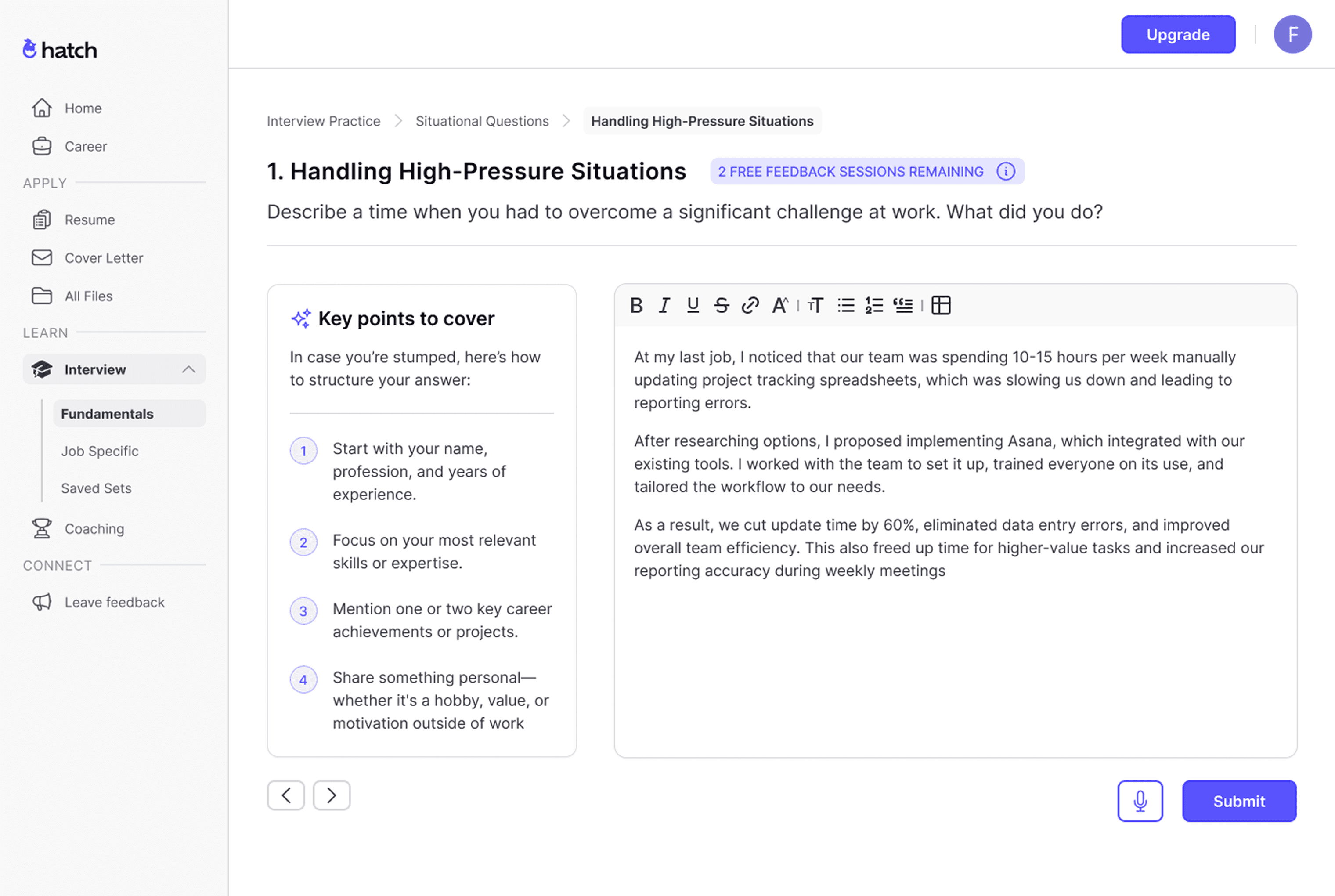
Hatch emphasizes applied execution and outcome visibility. Instead of focusing primarily on score improvement, it focuses on producing job-specific applications and tracking measurable engagement, participation, and employment outcomes.
In environments prioritizing job placement outcomes, the difference between improving a score and strengthening an application can influence strategic and funding decisions.
Final Perspective
VMock centers on structured evaluation and standardized scoring.
Hatch centers on contextual reconstruction and role-specific application strength.
They overlap in intent, but they operate at different layers of AI application.
If the goal is scalable resume evaluation and baseline benchmarking, VMock aligns well.
If the goal is producing fully reconstructed, job-specific applications with reduced user ambiguity, Hatch may align more naturally.
The distinction is less about feature presence and more about how deeply the system participates in execution.